AI Workstation vs AI Server: Does Your AI Workload Need a Personal Machine or Enterprise Computing Power?

Article Summary
AI Workstation: A powerful computer designed for individual AI developers, researchers and professionals running local AI workloads.
AI Server: A centralized computing system built to handle demanding AI workloads, support multiple users and scale computing resources.
The Key Difference: Workstations offer dedicated local performance, while servers provide shared resources, greater scalability and centralized management.
What happens when your AI model becomes too demanding for your computer to handle? Do you upgrade your workstation, or is it time to invest in an AI server?
As artificial intelligence becomes part of everyday business operations, choosing the right computing infrastructure is becoming increasingly important. From developing machine learning models to running enterprise-scale AI applications, the hardware behind these workloads directly affects performance and productivity.
Two popular options are AI workstations and AI servers. Although both use powerful GPUs and processors, they serve different purposes.
At Viperatech, we work with AI hardware, GPU computing systems and enterprise infrastructure designed for different computing requirements. Let's explore what separates these two systems and how to decide which one makes sense for your needs.
What Is an AI Workstation?
Think of an AI workstation as a high-performance computer built specifically for demanding professional workloads.
Unlike a regular desktop, an AI workstation typically combines powerful CPUs, dedicated GPUs, substantial memory and fast SSD storage to handle tasks such as:
AI model development:
Building, testing and fine-tuning machine learning models.
Local AI inference:
Running trained models directly on your computer.
Data science:
Processing datasets and performing complex computations.
Rendering and simulation:
Handling demanding graphics and computational workloads.
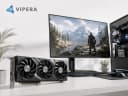
For example, an AI developer using an NVIDIA RTX PRO 6000 Blackwell workstation can run supported AI models locally, experiment with different configurations and process demanding workloads without depending entirely on cloud computing.
The biggest advantage? Dedicated computing resources that are readily accessible to an individual user or a small team.
What Is an AI Server?
An AI server takes computing power a step further by making powerful hardware available to multiple users, applications or workloads.
Instead of being designed primarily for one person's desk, AI servers are typically deployed in server rooms or data centers and managed centrally.
Their configurations can include:
Multiple GPUs:
Support parallel computing and demanding AI workloads.
High-capacity memory:
Handle larger datasets and memory-intensive applications.
High-speed networking:
Transfer data efficiently between GPUs, storage and connected systems.
Enterprise-grade components:
Support continuous operation and demanding business environments.
Scalable infrastructure:
Allow organizations to expand computing capacity as requirements grow.
Consider an organization training large AI models or operating AI-powered applications for thousands of users. A multi-GPU server platform, such as an NVIDIA HGX B200 or B300 system, can provide the computing infrastructure needed for these demanding workloads.
Unlike a workstation, an AI server is designed around centralized resource sharing, infrastructure management and expansion.
AI Workstation vs AI Server: What Are the Key Differences?
Both systems can deliver impressive AI performance, but their configurations and intended applications are different.
Feature | AI Workstation | AI Server |
Primary purpose | Individual AI computing | Enterprise AI workloads |
Users | Individual or small team | Multiple users or teams |
GPU configuration | Typically one or a few GPUs | Can support multiple high-performance GPUs |
Scalability | Limited by individual system configuration | Designed for infrastructure expansion |
Deployment | Office or desk-side | Server rooms or data centers |
Workloads | Development, testing and inference | Large-scale training and inference |
Management | Primarily local | Centralized management |
Investment | Generally lower entry cost | Generally higher infrastructure investment |
One important distinction: an AI workstation is not automatically less powerful than an AI server. A high-end workstation can outperform certain servers in specific workloads.
The real difference comes down to how computing resources are configured, accessed and managed.
Which One Should You Choose for Your AI Workload?
There is no universal winner. Your choice should depend on the size of your workloads, the number of users and your future computing requirements.
An AI workstation may be the better choice if:
You are an AI developer, researcher or data scientist.
You regularly experiment with machine learning models.
You need local AI development and inference capabilities.
Your workloads fit within one system's GPU memory and processing capacity.
You prefer dedicated hardware without managing shared infrastructure.
An AI server may be the better choice if:
Multiple employees need access to GPU computing resources.
You train larger AI models or run demanding inference workloads.
Your business needs centralized AI infrastructure.
You require multiple GPUs working together.
You anticipate expanding your computing requirements.
Interestingly, many organizations benefit from using both. Developers can build and test models on workstations before moving larger training and production workloads to centralized AI servers.
How Can Viperatech Help You Choose the Right AI Infrastructure?
Choosing AI hardware involves more than selecting a GPU with impressive specifications. Memory capacity, GPU configuration, networking, storage and workload requirements all matter.
Viperatech offers AI hardware and enterprise computing solutions designed for modern AI, machine learning and high-performance computing applications.
Its solutions include NVIDIA and AMD GPU technologies, AI workstations, Supermicro enterprise systems and scalable GPU infrastructure.
Whether you're exploring a professional AI workstation or planning a multi-GPU enterprise deployment, understanding your actual computing requirements is the first step towards choosing the right configuration.
AI Workstation or AI Server - What's Right for You?
The choice between an AI workstation and an AI server ultimately comes down to how you plan to use computing power.
If you need dedicated hardware for individual development, experimentation and local AI workloads, an AI workstation is a practical starting point. If your requirements involve multiple users, larger models, centralized computing and infrastructure expansion, an AI server is generally the more suitable solution.
And if your AI requirements are growing, combining both can offer a practical development-to-production workflow.
At Viperatech, you can explore AI workstations, enterprise GPU systems and AI hardware solutions designed to support evolving computing demands. The goal isn't simply to buy more computing power; it's to choose infrastructure that makes sense for the work ahead.